
If you are a small brand, you do not need brand awareness; you need sales. Wasting budget on vanity metrics like video views or clicks without conversions is a risk you cannot afford.
This means every dollar you spend on TikTok must be focused on one goal: getting the user to take a high-value action, such as a purchase or a sign-up.
Get Up to $6,000 in Free TikTok Ad Credits
TikTok offers ad credit incentives for new advertisers, helping you test campaigns with a lower upfront cost.
TikTok conversion ads are the answer. They use the platform’s powerful algorithm to bypass users who just scroll and find the users who actually buy.
The process is direct, but it demands strict adherence to technical prerequisites and creative authenticity.
The good news is that the platform is accessible: the minimum daily budget at the ad group level is just $20, meaning you can start testing today.
This blueprint walks you through the exact setup required to move beyond views and start seeing sales.
Table of Contents
Quick Summary
- Objective Choice: Always select the Sales objective (or the conversion objective specific to your goal) to train the algorithm to find buyers.
- Prerequisite: The TikTok Pixel must be installed and firing the purchase event before you launch any campaign.
- Minimum Budget: The daily ad group minimum is $20, but aim for $50/day at the campaign level to stabilize performance faster.
- The Learning Phase: Campaigns need approximately 25 conversions or 7 days to exit the learning phase; avoid making major edits during this time.
- Creative Strategy: Use authentic Spark Ad content that feels native to the ‘For You’ page, as creative quality directly impacts cost and conversion rate.
What are TikTok Conversion Ads?
TikTok Conversion Ads are campaigns set up with the primary objective of driving specific, high-value actions on a website or app, such as a purchase, a lead form submission, or a subscription.
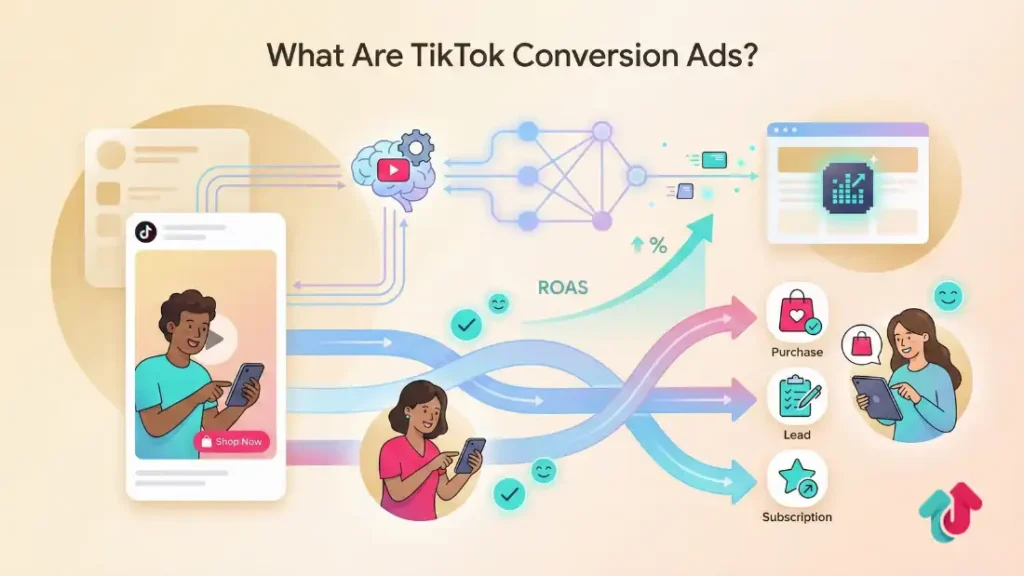
The TikTok algorithm uses data from the TikTok Pixel to optimize delivery, prioritizing users who are most likely to complete the defined action, thereby maximizing the advertiser’s Return on Ad Spend (ROAS).
Phase 1: The Non-Negotiable Setup
Before clicking the Create button, your infrastructure must be ready.
1. Install the TikTok Pixel
This is the single most critical step. The TikTok Pixel is the tracking code that tells the Ads Manager when a user clicks your ad and completes a purchase on your website.
Actionable Step: Install the Pixel immediately and verify that it is tracking standard events (View Content, Add to Cart, Purchase) using the TikTok Events Manager. Without the ‘Purchase’ event firing accurately, your campaign will fail to optimize for sales.
2. Choose the Right Objective
In TikTok Ads Manager, navigate to the Campaign level and select your goal.
Best Choice for Sales: Select Sales (formerly Website Conversions). This tells TikTok: I don’t just want clicks; I want people who complete the transaction.
Phase 2: Building the Campaign Blueprint
Follow the standard three-tier structure to build your conversion campaign.
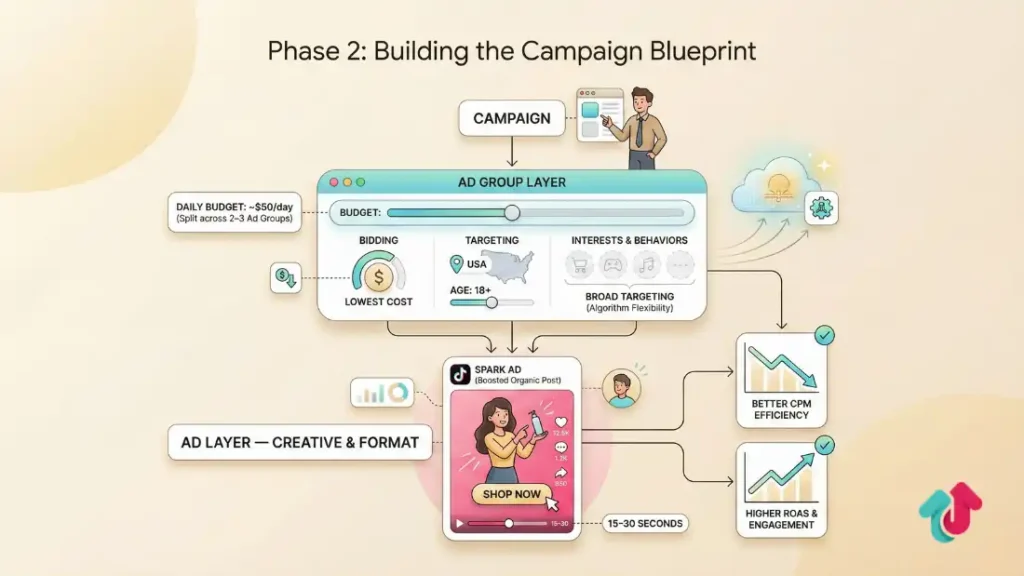
1. The Ad Group: Budget and Targeting
This is where small brands need to make crucial decisions about spending and audience size.
Budget Minimums: While the ad group’s daily minimum is $20, running campaigns below $50/day at the campaign level often yields sporadic results.
- Recommendation: Start with $50 daily allocated across 2-3 broad ad groups to accelerate the learning phase.
- Bidding Strategy: Choose the Lowest Cost to start. This allows TikTok to spend your budget efficiently while gathering data on conversion costs.
Targeting for Conversions: For small brands, Broad Targeting is the conversion-winning strategy in 2026.
- Actionable Step: Select your Location (e.g., USA). Set your Age (e.g., 18+). Leave Interests and Behaviors completely blank.
- Why Broad Works: It gives the algorithm maximum flexibility to find buyers, leading to lower CPM (Cost Per Mille) and better cost efficiency. The video creative will handle the actual filtering.
2. The Ad: Creative and Format
Your conversion rate is almost entirely dependent on your creative.
The Power of Spark Ads: Spark Ads (boosting existing organic posts) typically deliver a higher Return on Ad Spend (ROAS) for small businesses.
- Why: The ad looks native, carries social proof (likes/comments), and blends into the user’s feed, making it less likely to be skipped.
Creative Requirements:
- Video Duration: Aim for 15-30 seconds. This is enough time to introduce the problem, show the solution, and deliver a compelling Call-to-Action (CTA).
- CTA Button: Ensure the clickable button (e.g., Shop Now, Sign Up) aligns perfectly with your campaign goal.
Phase 3: Monitoring and Optimization
Your campaign will not be perfect immediately. Success relies on navigating the Learning Phase correctly.
The Learning Phase
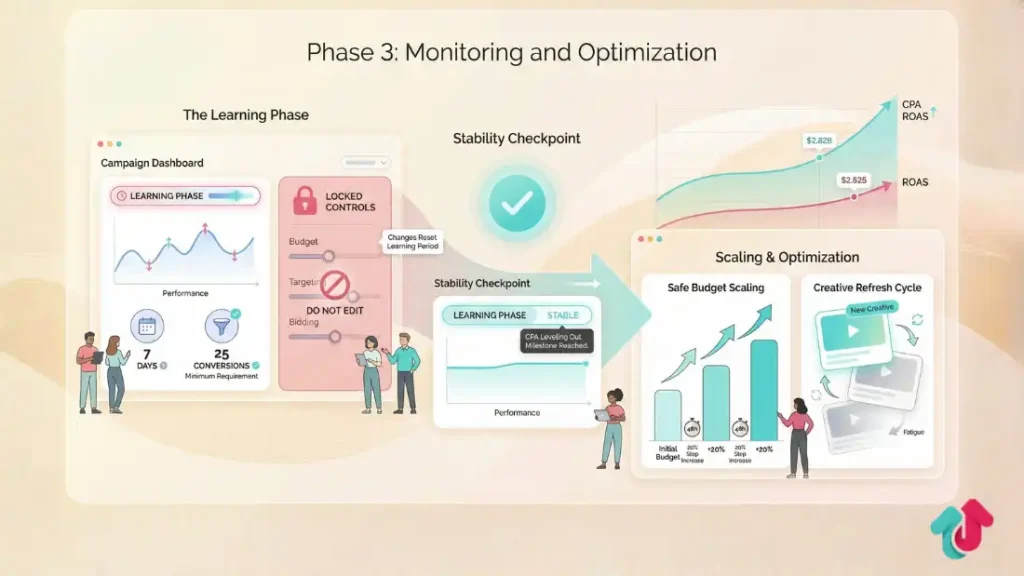
When a campaign is new, it enters a learning phase to gather data. This period is volatile, and costs are usually higher.
- Exit Requirement: The phase typically ends after generating 25 conversions (purchases or leads) or after 7 days of stable delivery.
- The Rule: Do not make major edits (budget, targeting, bidding strategy) during this phase, as this will reset the learning and force the algorithm to start over.
Scaling Strategies
Once the campaign is stable (exited learning and meeting your target CPA), you can scale the budget safely.
- Budget Increment Rule: Increase the daily budget by no more than 20% every 48 hours. This gradual increase allows the algorithm to adjust without spiking your costs.
- Creative Fatigue: Conversion ads fatigue quickly. Test 2-3 new creative variations every week to maintain performance.
FAQ: Conversion Ad Challenges
What is the minimum number of conversions needed per week?
To keep the ad set optimized and out of the learning phase, aim for 25 conversions per 7-day period. If you cannot meet this with the purchase event, consider optimizing for a higher-funnel event, like adding to cart temporarily.
Should I use Lookalike Audiences for conversion campaigns?
Yes, but only if they are based on high-quality data. Create Lookalikes based on your ‘Purchasers’ email list or users who have completed the ‘Purchase’ event on your Pixel. Avoid LALs based on low-intent data like ‘Website Visitors.’
What if my CPA is too high during the learning phase?
Check your Click-Through Rate (CTR). If the CTR is below 0.7%, your creative is the problem, and you should pause the ad and test a new video hook. High CPA with a decent CTR usually indicates a problem with your website or offer.
Should I run retargeting conversion campaigns?
Absolutely. Run a separate retargeting campaign targeting Custom Audiences of people who have visited your website in the last 30 days or users who have watched 75% of your video ads. This warm audience usually converts at a much higher rate.
What is the best bidding strategy for a small budget?
The Lowest Cost bidding strategy is best for small budgets because it ensures you spend your full daily budget while gathering the most data possible for the price.
Conclusion
TikTok offers small brands a high-leverage opportunity to drive direct sales efficiently. The key to successful conversion campaigns is rooted in technical discipline: ensuring the TikTok Pixel is flawless, respecting the minimum daily budget, and being patient through the Learning Phase.
By consistently testing authentic, native Spark Ads and trusting the algorithm with Broad Targeting, you can turn TikTok from a platform of awareness into a consistent engine for revenue.