
By default, TikTok ads can appear alongside nearly any content on the platform. This is not merely a hypothetical risk; it is the standard state for every campaign launched without proactive safety controls.
Brand managers and media buyers running TikTok campaigns in 2026 face a more complex environment than any previous year. The platform’s content scale, shifting ownership context, and tightened FTC-aligned policies mean that brand safety requires active configuration, not just awareness.
Get Up to $6,000 in Free TikTok Ad Credits
TikTok offers ad credit incentives for new advertisers, helping you test campaigns with a lower upfront cost.
This guide provides a comprehensive overview of TikTok brand safety: covering available native tools, 2026 policy updates, and the tactical steps required to protect your ad spend.
Table of Contents
Key takeaways:
- TikTok brand safety and brand suitability are two different layers. You need both to be active.
- The Inventory Filter, Category Exclusions, and Brand Safety Hub are your core native tools.
- Third-party partners (DoubleVerify, IAS, Zefr) add independent verification that TikTok’s native tools cannot provide.
- 2026 policy updates make AI content labeling and FTC-aligned disclosures mandatory, not optional.
- Brand safety requires ongoing maintenance, not a one-time setup.
What Is TikTok Brand Safety?
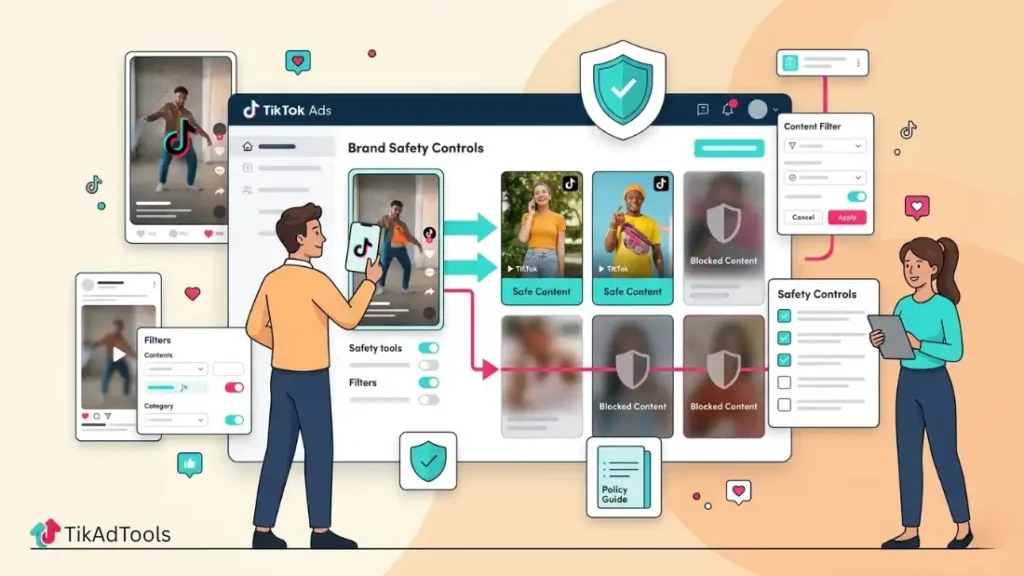
TikTok brand safety encompasses the controls, policies, and third-party integrations designed to prevent ads from appearing next to reputational risks. It operates on two layers: a universal safety floor aligned with the GARM framework to block harmful content, and a brand suitability layer where advertisers define industry-specific appropriateness.
Why TikTok Brand Safety Matters for Advertisers in 2026
Advertising dollars are at risk whenever a campaign runs without tailored safety configurations. For new accounts, the platform default often provides the least amount of protection.
TikTok has over 1.6 billion monthly active users globally. The platform’s content is almost entirely user-generated. That means your ad, by default, runs adjacent to content you have not reviewed and did not choose.
The reputational stakes are significant. When your ad appears next to content promoting harmful behavior, misinformation, or explicit material, users do not separate the ad from the surrounding content.
According to a study called “The Brand Safety Effect” conducted by CHEQ, Magna, IPG Mediabrands, and BMW, ads appearing near negative content cause a 2.8 times decrease in consumer intent to associate with brands. Two-thirds of consumers who expressed high purchase intent for a brand were less likely to buy after seeing that brand’s ad appear next to unsafe content.
The 2026 regulatory climate adds urgency. Following the December 2025 establishment of a new U.S. joint venture involving Oracle, Silver Lake, and MGX (each holding 15%), Oracle now serves as the Trusted Security Provider.
This transition, alongside increased FTC scrutiny, means advertisers in regulated categories—such as finance and healthcare—face higher compliance standards than ever before.
While TikTok has introduced a robust safety infrastructure, the responsibility lies with the advertiser to configure these tools. The primary risk is not the platform itself, but rather leaving these sophisticated controls in their default, unoptimized state.
TikTok Brand Safety vs. Brand Suitability: What’s the Difference?
Most guides treat these terms as synonyms. They are not, and confusing them leads to campaigns that are technically compliant but still brand-damaging.
Brand safety is the non-negotiable floor. It defines content categories that no responsible advertiser should appear next to, regardless of industry. This includes graphic violence, hate speech, illegal activity, content that exploits minors, and terrorism-related content.
TikTok aligns its safety floor with the GARM Brand Safety Floor and Suitability Framework, the industry standard originally developed by the Global Alliance for Responsible Media. Note that GARM as an organization was dissolved in August 2024 following legal action, but its Brand Safety Floor and Suitability Framework remains the reference standard that TikTok and all major verification partners continue to follow.
Brand suitability sits above that floor. It covers content that passes the safety floor (legal, not universally harmful) but may still be wrong for your brand specifically. A children’s toy brand would exclude mature humor and political commentary. A premium spirits brand would exclude content targeting younger demographics, even if that content passes every safety check.
| Dimension | Brand Safety | Brand Suitability |
| What it blocks | Universally harmful content | Brand-specific misalignment |
| Who defines it | GARM framework standard | You, based on your brand guidelines |
| Example exclusion | Graphic violence | Political commentary |
| Control type | Platform-enforced floor | Advertiser-configured layer |
| Applies to | All advertisers equally | Your campaigns only |
| Can you override it? | No | Yes, within policy limits |
You need both layers active and configured separately. The safety floor alone is not sufficient protection for a brand with a specific audience, a regulated product, or a premium positioning strategy. Your suitability layer is where your brand’s actual risk profile gets addressed.
Inside TikTok’s Brand Safety Suite: Every Tool Explained
TikTok’s Brand Safety Suite lives inside TikTok Ads Manager. You can configure it at the account level, so every campaign inherits a baseline, or override settings at the individual campaign level for specific use cases. Here is every tool available and exactly what it does.
Inventory Filter: This is the primary control for managing your ad adjacency environment.
It segments inventory into three tiers:
- Expanded: Your ads will not appear next to explicitly inappropriate content, but they may appear next to content that features mature themes. Appropriate for performance-focused campaigns where reach outweighs adjacency risk.
- Standard: Excludes the highest-risk content categories. Your ads will appear next to content appropriate for most brands, but may include some mature themes. This is the recommended default for most brand advertisers.
- Limited: The most restrictive tier. Your ads appear only next to content that contains no mature themes at all. Best for brands in sensitive verticals such as children’s products, healthcare, and financial services.
Category Exclusion Beyond the Inventory Filter tiers, you can exclude specific content categories from your ad delivery. Available categories include alcohol, gambling, tragedy and conflict, safe sex and family planning, profanity, and several others. You select the categories that conflict with your brand values. TikTok removes those placements from your campaign delivery automatically.
Vertical Sensitivity: This setting communicates your industry category to TikTok’s delivery algorithm. Providing this context activates additional sensitivity filters based on the regulatory and community standards specific to your vertical. It is particularly important for healthcare, financial services, and children’s product advertisers.
Video Exclusion List: You can upload a list of specific TikTok video IDs you never want your ad to appear adjacent to. This granular control goes beyond category-level filtering. Use it when specific content types or individual creators repeatedly create adjacency issues that category exclusions do not catch.
Profile Feed Exclusion List: This control blocks entire TikTok creator accounts from your ad delivery. Your ads will not appear within any content published by those accounts. Build this list from your Brand Safety Hub reports and from your own campaign audits.
Comment Management: You can filter, hide, and moderate comments on your TikTok ads directly inside Ads Manager. Keyword filters automatically hide comments containing flagged terms before other users see them. This is one of the most underused tools in the suite. Comment-section toxicity on a well-placed ad can undermine the campaign’s brand impact significantly.
Brand Safety Hub: The Brand Safety Hub is your central dashboard for managing all of the above controls. It also provides performance reporting across campaigns, including flagged content incidents, delivery breakdowns by inventory tier, and third-party verification data if you have integrated a partner like DoubleVerify or IAS.
Pre-bid vs. Post-bid Safety Controls: What Advertisers Need to Know
TikTok brand safety controls operate at two distinct campaign stages. Knowing which tools apply at which stage determines how you structure your protection.
Pre-bid controls are configured before your ad delivers. They determine which inventory your ad is eligible to serve against:
- Inventory Filter (Expanded, Standard, or Limited)
- Category Exclusion selections
- Vertical Sensitivity configuration
- Video Exclusion List uploads
- Profile Feed Exclusion List uploads
Post-bid controls monitor and act on content after your ad has served:
- Comment Management keyword filters
- Brand Safety Hub performance alerts and flagged incident reports
- Third-party verification reports from DoubleVerify, IAS, or Zefr
Pre-bid controls reduce risk before exposure occurs. Post-bid controls catch what gets through and inform your next round of pre-bid refinements. You need both stages covered. Pre-bid alone gives you prevention without visibility into what is slipping through. Post-bid alone means your brand is already exposed before you can act on the data.
Third-Party Brand Safety Partners: DoubleVerify, IAS, and Zefr Compared
Because TikTok’s native tools are self-reported, enterprise brands often require independent verification. Three primary partners lead this space: DoubleVerify, Integral Ad Science (IAS), and Zefr.
| Feature | DoubleVerify | IAS | Zefr |
| Core function | Brand safety + viewability measurement | Brand safety + fraud detection | Content-level brand suitability |
| TikTok integration | Direct API | Direct API | TikTok-native partner |
| Pre-bid targeting | Yes | Yes | Yes |
| Post-bid reporting | Yes | Yes | Yes |
| Cross-platform support | Yes (broad) | Yes (broad) | TikTok-focused |
| Best for | Brand advertisers need cross-platform consistency | Performance buyers prioritizing fraud detection | Brands needing video-level suitability |
| Pricing model | CPM-based fee | CPM-based fee | Custom enterprise pricing |
DoubleVerify is the strongest choice if cross-platform consistency matters to your reporting. If you are running brand safety measurement across TikTok, YouTube, and programmatic inventory, DoubleVerify gives you a unified reporting view. It is widely used by enterprise brand advertisers because its methodology is consistent and auditable.
IAS is the right choice if ad fraud detection is as important to you as content safety. IAS runs one of the most robust invalid traffic detection models in the industry. If you are running performance campaigns on TikTok where fraudulent engagement inflates your cost-per-result, IAS provides protection that DoubleVerify does not prioritize to the same degree.
Zefr specializes in video-level suitability. Unlike category-level classification, Zefr evaluates individual videos. According to their data, campaigns using these tools have maintained 99%+ brand safety ratings on TikTok since 2022. For example, Adidas achieved 99.9% safety and suitability ratings by combining native filters with Zefr’s measurement tools.
Third-party verification adds CPM costs that vary based on the partner, campaign scope, and contract terms. For campaigns with smaller budgets, the cost-benefit calculation may favor native tools only. For campaigns in regulated categories or with significant brand sensitivity requirements, independent verification is worth the additional investment.
How to Set Up Brand Safety Controls in TikTok Ads Manager (Step-by-Step)
Configure brand safety at the account level first. This ensures every new campaign inherits your baseline protection automatically. Then override at the campaign level only where your risk profile genuinely differs.
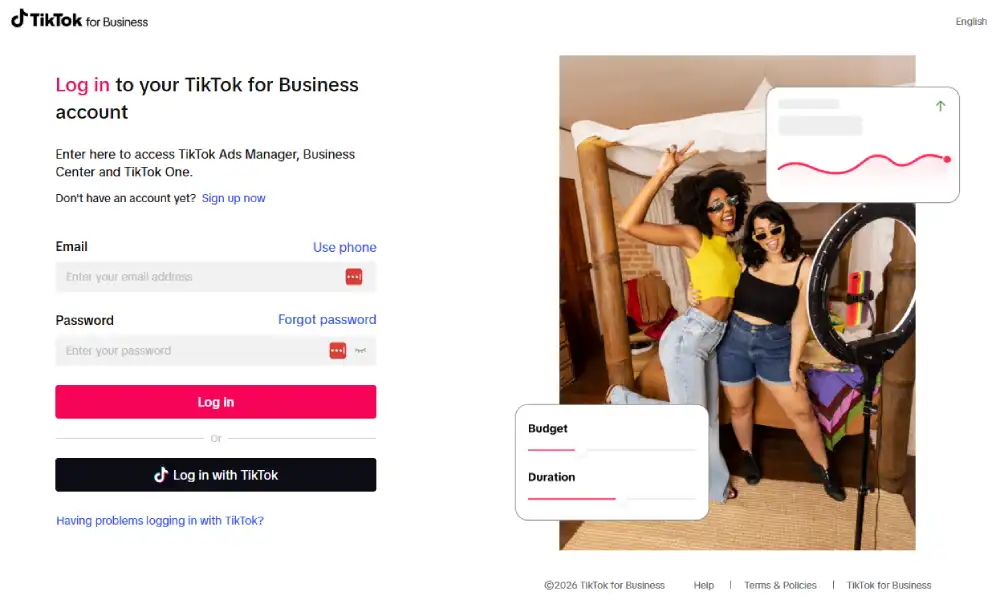
1. Log in to TikTok Ads Manager and go to your account dashboard.
2. Click “Settings” in the left navigation menu, then select “Brand Safety.”
3. Open the Brand Safety Hub. This is your central control panel for all safety settings.
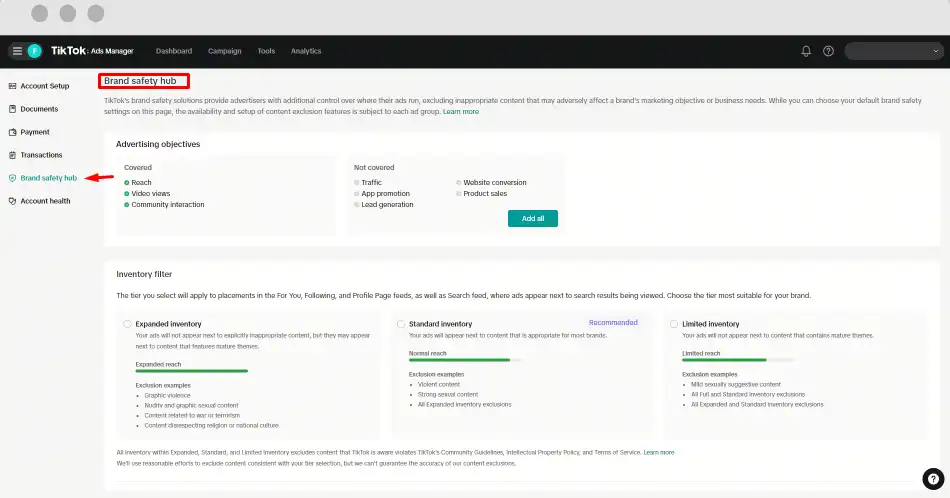
4. Set your default Inventory Filter. Choose Standard for most brand campaigns. Choose Limited if you are in a sensitive category like children’s products, health, or financial services.
5. Configure Category Exclusions. Select every content category that conflicts with your brand guidelines. Be specific: over-excluding restricts reach without meaningfully improving safety outcomes.
6. Set your Vertical Sensitivity. Select the industry category that best matches your brand. This activates additional platform-level filters suited to your vertical.
7. Upload your Video Exclusion List if you have identified specific video IDs to block from prior campaign audits. You can also export a list from your Brand Safety Hub reporting after your first campaign completes.
8. Upload your Profile Feed Exclusion List for any creator accounts consistently creating adjacency problems for your brand.
9. Set up Comment Filters. Add your flagged keyword list in the Comment Management section to auto-hide problematic comments before other users see them.
10. Connect a third-party verification partner through the Measurement Partners section in Ads Manager if your budget and risk profile warrant independent verification.
11. Save your settings as account-level defaults. Every new campaign will inherit this baseline unless you override it at the campaign level.
At the campaign level, you can override account defaults for specific scenarios. A broad performance campaign may use Expanded Inventory to maximize reach. A premium brand awareness campaign should stay on Standard or Limited regardless of budget size.
How to Block Sponsored Ads and Manage Ad Visibility on TikTok
TikTok users can report and hide ads they find irrelevant, inappropriate, or misleading. Understanding how this works from the user side helps you manage your ad’s visibility and reputation in the feed.
When a user wants to remove a sponsored ad from their TikTok feed, they tap the three-dot icon on the ad and select “Not Interested” or “Report Ad.” Selecting “Not Interested” removes the ad from that user’s feed and sends a negative relevance signal to TikTok’s delivery algorithm. Selecting “Report Ad” sends the creative to TikTok’s review team for policy compliance assessment.
For you as an advertiser, a rising “Not Interested” rate is a warning signal. TikTok Ads Manager does not surface this metric directly, but you can infer it: declining engagement rates combined with rising frequency often indicate that your creative or targeting is generating negative user feedback. When you see those patterns together, review your audience targeting and creative relevance before assuming a safety issue.
You cannot prevent users from reporting your ads. What you can do is ensure your ads are clearly labeled as sponsored, accurately represent your product or service, and comply fully with TikTok’s Advertising Policies. Compliant, well-targeted ads generate significantly fewer negative user signals than broad placements with weak creative relevance.
TikTok Brand Safety Policy Updates for 2026: What’s New
TikTok introduced several meaningful policy changes in late 2025 and continuing into 2026. These updates affect your compliance requirements, your creative production process, and your account verification status in regulated categories.
AI Content Labeling TikTok requires creators to label AI-generated content that contains realistic images, audio, or video. This policy applies to content that has been wholly or significantly generated by AI. TikTok integrates C2PA Content Credentials to automatically detect and label some AI content, but the responsibility for compliance in advertising falls on you as the advertiser.
If your creative team uses AI generation tools to produce ad visuals, voiceovers, or video, those assets must carry the required disclosure label. AI-assisted workflow tools such as script writing, caption generation, and hashtag suggestions are exempt from the labeling requirement. The rule targets the visual and audio output itself, not the planning process around it.
FTC-Aligned Disclosure Rules TikTok’s Branded Content Policy requires explicit disclosure for paid partnerships and sponsored posts. This aligns with FTC endorsement and testimonial guidelines, which require clear disclosure when there is a material connection between an advertiser and the person promoting a product. TikTok enforces this with both its Branded Content toggle in Ads Manager and automated detection systems. Non-compliant campaigns face delivery restrictions.
TikTok U.S. Ownership Change In January 2026, TikTok USDS Joint Venture LLC was formally established following binding agreements signed in December 2025. Oracle, Silver Lake, and MGX each hold 15% stakes in the new entity, while ByteDance retains a 19.9% stake. Oracle serves as the Trusted Security Provider, managing all U.S. user data within Oracle’s U.S. cloud infrastructure.
The content recommendation algorithm is being retrained using only U.S. user data under the oversight of the new majority-American board. For advertisers, the day-to-day experience inside TikTok Ads Manager remains unchanged. If your organization has data residency or compliance requirements, contact TikTok’s enterprise team to confirm which governance framework applies to your specific account.
These updates raise the compliance baseline for all TikTok advertisers. They do not make the platform harder to use. They make well-configured, transparent campaigns the clear standard and make non-compliant campaigns more visible to platform enforcement.
TikTok Brand Safety Best Practices: A Marketer’s Action Checklist
Run through this checklist before, during, and after every TikTok campaign. Each item represents a protection layer that most advertisers skip at least once.
Before your campaign launches:
- Set your account-level Inventory Filter to Standard or Limited as your default baseline
- Complete your Category Exclusion list based on your brand guidelines, not just TikTok’s suggested defaults
- Upload a Video Exclusion List built from previous campaign audits or competitive intelligence
- Verify all AI-generated creative assets include the required TikTok AI content disclosure label where applicable
- Confirm the Branded Content toggle is active for all creator partnerships.
- Complete industry-specific account verification if you are in a regulated category (finance, health, alcohol)
- Brief your creative team on TikTok’s Advertising Policies before production begins
During your campaign:
- Check your Brand Safety Hub weekly for flagged content incidents and delivery anomalies
- Review comment sentiment on your active ad placements at least twice per week
- Monitor frequency and engagement rate trends together to identify negative user feedback patterns early
- Compare third-party verification reports (if active) against TikTok’s native Brand Safety Hub data
After your campaign ends:
- Export your Video Exclusion List and add any new problem placements for future campaigns
- Audit whether your Category Exclusion selections meaningfully improved safety or primarily restricted reach without benefit
- Request a brand suitability report from your third-party verification partner if applicable
- Update your account-level defaults based on what you observed during the campaign
Brand safety is not a setup task. It is a process that improves with every campaign cycle. The brands that protect their TikTok investment most effectively treat their exclusion lists, verification reports, and hub settings as living documents they update after every flight.
Explore these helpful articles next:
👉 TikTok Ads Credit, Coupon, and Promo Code: How to Get Up to $6,000 in Free Ad Spend
👉 TikTok Dynamic Showcase Ads: eCommerce Personalization
👉 Targeting TikTok Users by Interest: Full List & Tips
👉 Best TikTok Ads for Pet Brands (Examples & Ideas)
Frequently Asked Questions
What is brand safety on TikTok?
TikTok brand safety refers to the set of controls, policies, and tools that prevent your ads from appearing next to content that could damage your brand’s reputation. It includes native tools like the Inventory Filter, Category Exclusions, and Comment Management inside TikTok Ads Manager, as well as third-party verification integrations with partners like DoubleVerify, IAS, and Zefr. You manage all native brand safety settings through the TikTok Brand Safety Hub.
Are TikTok ads safe for brands?
TikTok ads can be safe for brands when you configure the available safety controls correctly before your campaigns go live. TikTok’s Inventory Filter, Category Exclusion settings, and third-party verification integrations significantly reduce adjacency risk when properly set up. Without these controls active, your ads can appear next to content that conflicts with your brand values. The level of safety you achieve depends directly on your campaign configuration, not just the platform’s defaults.
How do I ensure brand safety on TikTok ads?
To ensure brand safety on TikTok ads, start by setting your account-level Inventory Filter to Standard or Limited in the Brand Safety Hub. Then configure your Category Exclusions based on your brand guidelines, upload a Video Exclusion List from prior campaign data, and set keyword filters in Comment Management. For campaigns in regulated industries or with large budgets, connect a third-party verification partner through TikTok’s Measurement Partners section and review your Brand Safety Hub reports weekly.
What is the difference between brand safety and brand suitability on TikTok?
Brand safety on TikTok is the non-negotiable content floor based on the GARM Brand Safety Floor framework, blocking categories like graphic violence, hate speech, and illegal activity. Brand suitability is the customizable layer above that floor, where you define which legal but potentially misaligned content categories to exclude based on your specific audience and brand values. Both layers require separate configuration. The safety floor is enforced by TikTok at the platform level; the suitability layer is built and managed by you inside Ads Manager.
Which third-party tool is best for TikTok brand safety: DoubleVerify, IAS, or Zefr?
The right choice depends on your primary goal. Use DoubleVerify for cross-platform brand safety and viewability measurement if you are running campaigns across TikTok, YouTube, and programmatic channels. Use IAS if ad fraud detection and invalid traffic measurement are as important as content safety. Use Zefr if you need video-level brand suitability targeting with the most granular content classification available on TikTok. All three integrate directly with TikTok Ads Manager through the Measurement Partners section.
Conclusion
TikTok brand safety is not a platform feature you turn on once. It is a system you build, test, and refine across every campaign you run.
We have covered what brand safety actually means on TikTok, why the distinction between safety and suitability matters for your specific campaign setup, and how TikTok’s native tool suite, from the Inventory Filter to the Brand Safety Hub, gives you far more control than most advertisers use.
You now know how to evaluate DoubleVerify, IAS, and Zefr based on your actual priorities rather than vendor claims. You know how to set up your safety controls step-by-step in Ads Manager.
The 2026 policy updates, AI content labeling requirements, FTC-aligned disclosure rules, and off-platform promotion restrictions raise the compliance baseline for every advertiser on the platform. They are not optional, and the brands that treat them as such will face delivery restrictions and review rejections that compliant competitors avoid.
Your TikTok ad spend is only as protected as the controls you put in place before your campaigns go live. Configure them deliberately, review them consistently, and update them after every campaign. That is what separates brands that trust TikTok with their budgets from brands that have learned not to.