
Marketing on TikTok in 2026 is not a targeting game; it is a creative game. The algorithm has become so efficient at finding buyers that your Interest Settings matter far less than your Hook Rate.
However, most brands approach creative testing incorrectly. They upload two completely different videos, different angles, different scripts, different offers, and when one performs better, they have no idea why. Was it the creator? The music? The first three seconds?
Get Up to $6,000 in Free TikTok Ad Credits
TikTok offers ad credit incentives for new advertisers, helping you test campaigns with a lower upfront cost.
To lower your CPA (Cost Per Acquisition) consistently, you must stop throwing spaghetti at the wall and start acting like a scientist.
You need a structured testing protocol that isolates specific variables to uncover exactly what triggers a purchase.
This guide outlines the Modular Testing framework, helping you build a predictable engine for finding winning ads without wasting budget on random experiments.
Table of Contents
Quick Summary
- The One Variable Rule: Never test two things at once. If you change the Hook and the Music, you won’t know which change caused the result.
- The Modular Approach: Film one Body (the product demo) and three different Hooks (intros). Combine them to create three distinct ads to test.
- Budget per Test: Allocate at least 5x your Target CPA to a testing campaign to ensure statistical significance.
- Primary Metric: Judge creative quality by Hook Rate (2-second views) and Hold Rate (6-second views). Judge financial success by CPA.
- Duration: A valid A/B test typically needs 48 to 72 hours to gather actionable data.
What is TikTok Creative A/B Testing?
TikTok Creative A/B Testing is the systematic process of running two or more variations of an ad simultaneously to determine which specific element (the variable) drives better performance.
Unlike standard campaign optimization, which focuses on audience, creative testing isolates elements like the visual hook, voiceover script, background music, or Call-To-Action to provide data-driven insights for future content production.
1. What Creative Variables Should I Test First?
Not all tests are created equal. Changing the background music might improve retention by 5%, but changing the visual hook can improve conversion by 200%. Prioritize your testing budget based on this hierarchy of impact.
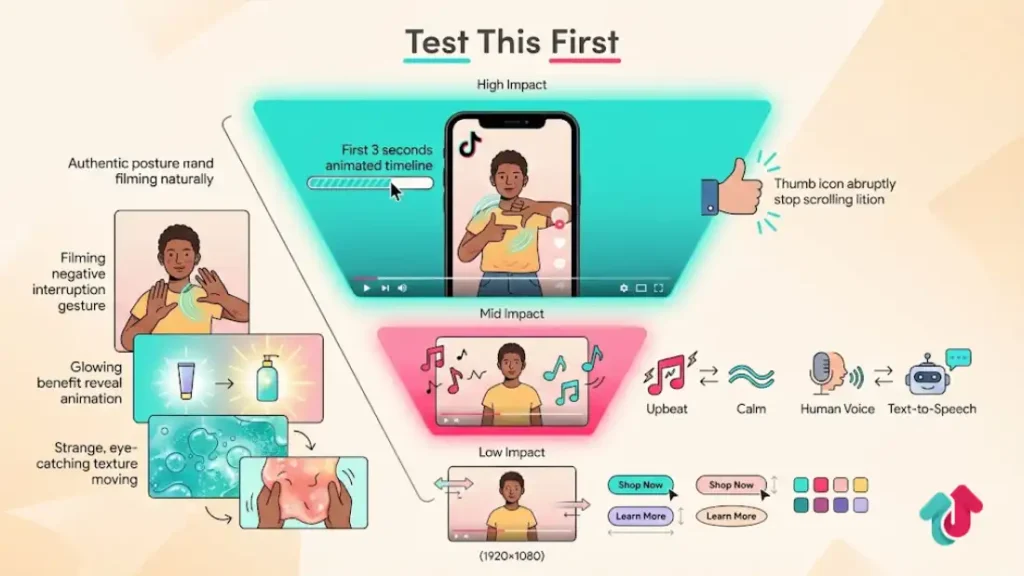
The High-Impact Tier (Start Here)
The Visual Hook (0-3 Seconds): This is the single most important variable.
Test A: A Negative Hook (e.g., Stop doing this…).
Test B: A Benefit Hook (e.g., How to get glass skin…).
Test C: A Visual Shock Hook (e.g., A strange texture or movement).
The Opening Line (Script): The first sentence spoken.
Test: I found the best… vs. Don’t buy this until…
The Mid-Impact Tier (Refinement)
The Audio Track: Music sets the mood.
Test: Trending/Upbeat Audio vs. ASMR/Quiet Audio.
The Voiceover (VO): The delivery mechanism.
Test: A real human voice vs. the TikTok Text-to-Speech (Siri) voice.
The Low-Impact Tier (Optimization)
The CTA Button: Shop Now vs. Learn More.
Text Overlay Colors: Red text vs. Green text.
Note: Only test these once you have a winning video that you want to squeeze extra profit from.
2. How to Set Up the Modular Testing Structure
Do not film three separate videos. That is expensive and inefficient. Use the Modular Editing Strategy.
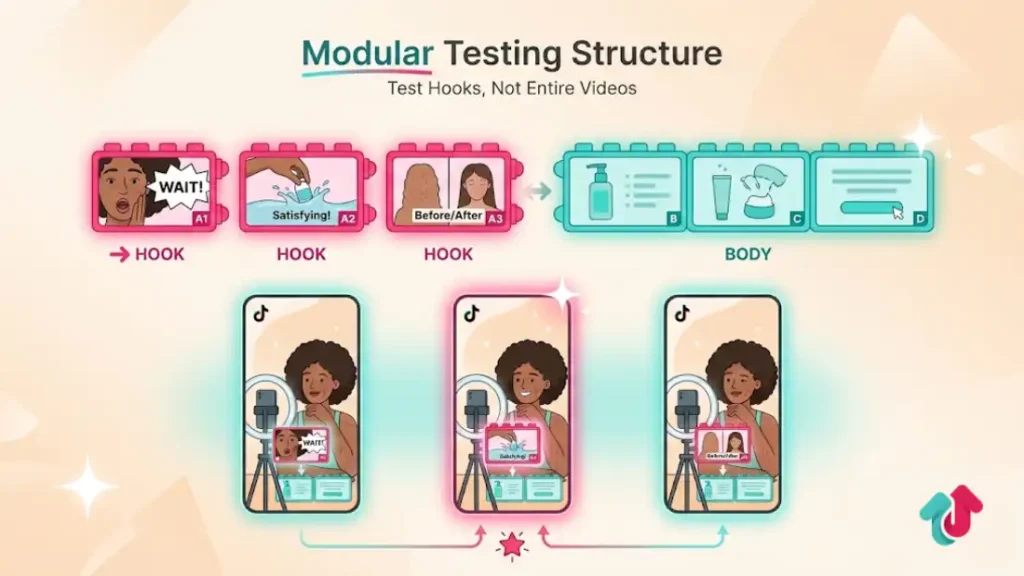
The Concept
Think of your video in blocks (LEGOs):
- Block A: Hook (0-3s)
- Block B: Problem/Agitation (3-10s)
- Block C: Solution/Demo (10-25s)
- Block D: Call to Action (25-30s)
The Execution
- Film: Record 3 different Hooks (Block A1, A2, A3) and 1 strong Body (Blocks B+C+D).
- Edit: Create 3 video files:
- Video 1: Hook 1 + Body
- Video 2: Hook 2 + Body
- Video 3: Hook 3 + Body
- Upload: Launch these three videos in a single Ad Group.
- Result: Since the Body is identical, any difference in performance is 100% due to the Hook. You now know exactly which intro grabs attention.
3. Which Testing Tool Should You Use?
TikTok Ads Manager offers two ways to run these tests.
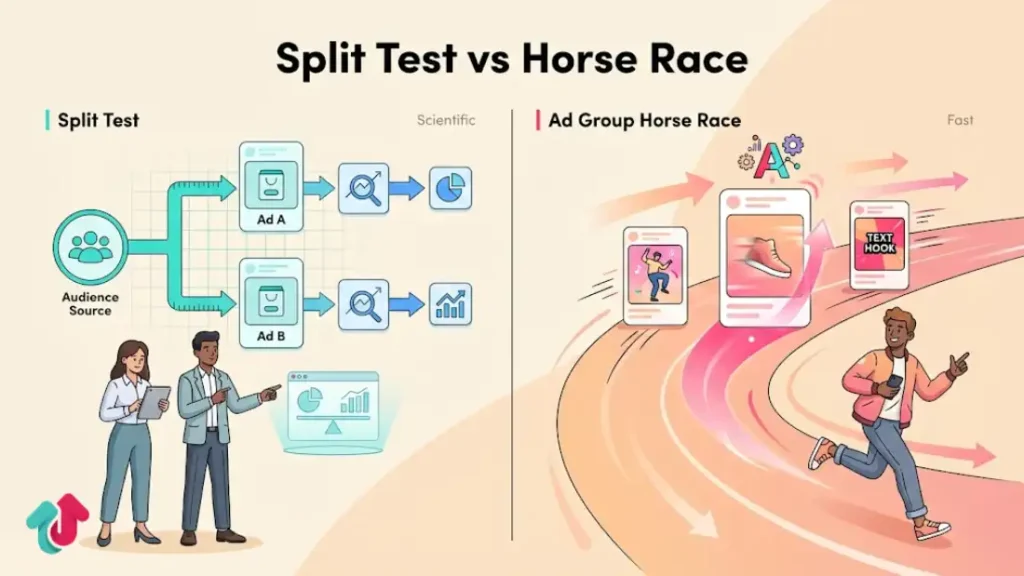
Method A: The Split Test Tool (Scientific)
Located in Tools > Split Test.
- How it works: It splits your audience strictly. If User X sees Ad A, they will never see Ad B.
- Pros: Scientifically accurate data. Eliminates audience overlap.
- Cons: Slower to setup. Requires higher minimum budget.
- Best For: Large brands with big budgets validating major concepts.
Method B: The Ad Group Horse Race (Speed)
- How it works: You put 3-5 ads in one Ad Group and let the algorithm decide.
- Pros: Fast. Mimics real-world delivery. The algorithm naturally pushes the budget to the winner.
- Cons: Not scientifically perfect (some users might see both ads), but practically effective.
- Best For: Dropshippers, SMBs, and rapid creative iteration. (Recommended for most).
4. How to Analyze A/B Test Results
After running the test for 48 hours, you will have a pile of data. Here is how to read it to make a Kill or Scale decision.
The Diagnostic Metrics (Why it happened)
- Hook Rate (2-Second Views / Impressions):
- Goal: >30%.
- Insight: If Ad A has a 35% Hook Rate and Ad B has 15%, Ad A is the winner, even if Ad B got a lucky sale. Ad A is scalable; Ad B is not.
- Hold Rate (6-Second Views):
- Goal: >8-10%.
- Insight: If the Hook Rate is high but Hold Rate is low, your Hook was Clickbait and didn’t match the rest of the video.
The Financial Metrics (The Result)
- CPA (Cost Per Acquisition): The ultimate arbiter.
Insight: If Ad C has a lower Hook Rate but the lowest CPA, it means the video filtered out window shoppers and attracted real buyers. Scale Ad C.
Explore these helpful articles next:
👉 How to Analyze TikTok Ad Performance: A Beginner Workflow
👉 Retargeting with TikTok Ads: Remarketing Strategies That Work
👉 TikTok Ads Metrics Explained: CPC, CTR, CPM, ROAS & More
👉 TikTok Video Specs for Ads: Dimension, Ratio, Safe Zones
FAQ: Creative Testing
How much budget do I need for an A/B test?
A general rule is 5x your Target CPA per ad group. If you want to acquire a customer for $20, you should be prepared to spend $100 on the test to get statistically significant data.
How long should I run a creative test?
Run the test for at least 48 hours. TikTok’s attribution can be delayed. Stopping a test after 6 hours because it hasn’t sold yet is a rookie mistake.
Should I use Automated Creative Optimization (ACO)?
Yes, ACO (now often integrated into Smart Creative) is excellent for testing combinations. You upload 3 videos and 3 text headlines, and TikTok mixes and matches them to find the winner. This is often more efficient than manual testing for small teams.
What do I do with the loser ads?
Turn them off (Pause). Do not delete them, as the data is useful for historical reference.
Can I test organic TikTok posts as ads?
Yes. Using Spark Ads to test organic content is a great strategy. Post 3 videos organically. If one gets significantly more views/likes, that is your Winner. Pull that video into Ads Manager and put budget behind it.
Conclusion
The goal of A/B testing on TikTok is not just to find a winning ad; it is to find a winning formula.
By using the Modular Editing approach, you stop guessing. You learn that Hook A (the visual shock) works better than Hook B (the question).
You take that knowledge and apply Visual Shock to your next batch of creatives. This iterative process turns luck into a repeatable system, allowing you to scale your account with confidence in 2026.