
If you’re a small business owner looking to start advertising on social media, the question of TikTok ads vs Facebook ads is probably the most debated question you have in your mind, right now.
Both platforms offer massive reach and solid targeting. But they work very differently, and what converts on one can fall flat on the other.
This guide breaks down the real differences so you can make a smart call before spending a dollar.
In this guide, you will learn:
- Audience size and who’s actually using each platform
- Ad formats and what creative you’ll need
- Targeting depth and retargeting capability
- Costs, budgets, and ROI benchmarks
- Which business types get the most from each platform
By the end, you’ll have a clearer picture of where your budget belongs and why the answer is not always obvious.
Get Up to $6,000 in Free TikTok Ad Credits
TikTok offers ad credit incentives for new advertisers, helping you test campaigns with a lower upfront cost.
Table of Contents
Key Takeaways
- Facebook reaches a broader, older audience with one of the most advanced ad targeting systems available.
- TikTok skews younger and drives strong engagement, especially for brands with short-form video content.
- Facebook Ads are better suited for retargeting, lead generation, and campaigns targeting users 30 and older.
- TikTok Ads work well for brand awareness and reaching buyers between 18 and 34 at a competitive cost.
- Running both platforms is possible, but start with one until your strategy is proven.
Quick Answer
Facebook Ads offer deeper targeting, stronger retargeting tools, and a broader audience, making them the more reliable choice for most small businesses. TikTok Ads can deliver strong awareness results at lower costs, particularly for brands targeting users under 35 with video content. The best platform depends on your product, audience age, and ability to produce short-form video consistently.
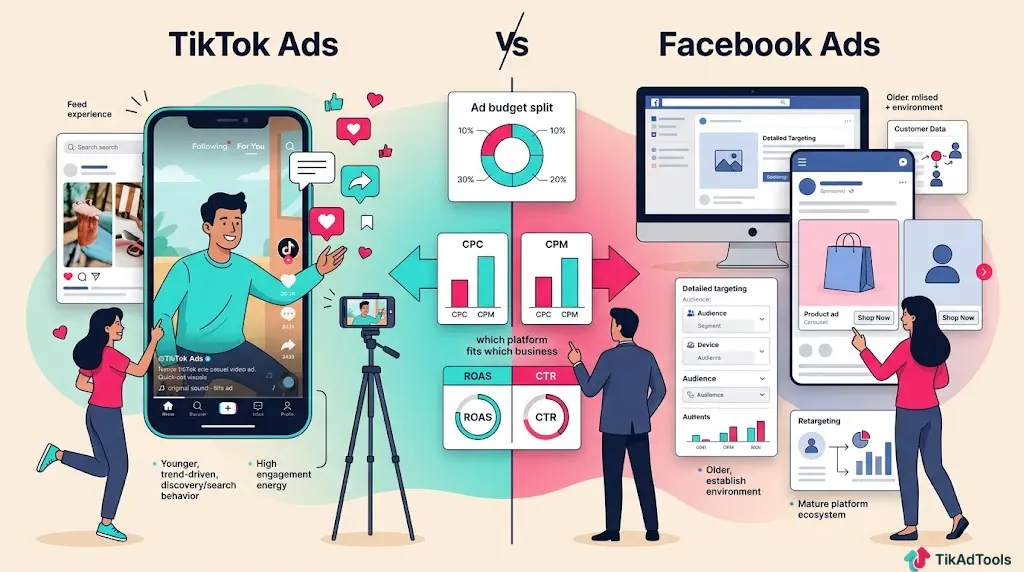
What are you actually comparing?
Facebook Ads run across Facebook, Instagram, Messenger, and the Meta Audience Network.
A single campaign can reach users across all four placements, giving you broad coverage without managing separate accounts.
Meta has been refining its ad system since 2007, and the targeting depth it has built over that time is hard to match.
TikTok Ads launched for global advertisers around 2020 and have grown quickly since. The platform is built entirely around short-form video, and its ad system places paid content directly inside the native feed.
What sets TikTok apart is its algorithm: it surfaces content to highly relevant viewers even when targeting settings are broad, which can work in your favor as an advertiser.
Audience size and demographics
Meta stopped reporting a Facebook-specific monthly active user count after Q4 2023, reporting only combined Family of Apps figures (Facebook, Instagram, WhatsApp, and Messenger together) since then. The last individually reported Facebook MAU figure, per Meta’s Q4 2023 earnings report, was 3.07 billion, and Facebook remains the largest single platform inside that family by a wide margin. Its user base spans nearly every age group, but the 25-to-54 demographic is especially active and represents strong purchasing power.
If your customers are working adults, the vast majority of them are reachable on Facebook.
TikTok’s ads reach 1.9 billion users globally, per Statista’s ad-planning-tool data (this is ad reach, not a directly reported MAU figure, since TikTok itself doesn’t publish one). Per Exploding Topics’ TikTok demographics data, the platform’s largest single age segment is now 25 to 34, though the broader 18-to-34 range still makes up the majority of its audience. TikTok is also steadily gaining users in the 35-plus range, so writing it off as a platform for teenagers is no longer accurate.
The practical takeaway: if you sell to a broad adult audience across age groups, Facebook gives you more scale. If your product resonates with Millennial and Gen Z buyers or you want to reach them specifically, TikTok is a real option worth testing.
Ad formats: what each platform offers
Facebook supports a wide range of formats, which gives you creative flexibility:
- Image ads
- Video ads
- Carousel ads (multiple images or videos in one unit)
- Collection ads (product catalogs with a cover image or video)
- Stories and Reels ads
- Lead generation forms are built directly into the platform
TikTok is primarily a video environment, but it offers several placement types:
- In-Feed Ads (native video in the main For You feed)
- TopView Ads (full-screen video that appears when the app opens)
- Spark Ads (boosting existing organic posts from your account)
- Branded Hashtag Challenges (for larger campaigns)
- Collection Ads (for e-commerce product discovery)
If you need variety across formats or want to run static image ads alongside video, Facebook gives you more options.
TikTok requires video, and ideally, video that feels natural in the feed. Short, authentic clips tend to outperform polished, commercial-style productions on TikTok.
Targeting capabilities: where Facebook still leads
Facebook’s targeting system is built on nearly two decades of user data. You can define audiences by age, location, interests, behaviors, life events, job titles, income level, purchase behavior, and more.
Lookalike audiences, where Meta finds users who share traits with your existing customers, are particularly effective for scaling campaigns.
TikTok’s targeting has improved year over year and covers age, gender, location, interests, device type, and behavioral signals. But it does not have the same data depth as Meta, and its behavioral targeting is less granular at this stage.
Where TikTok compensates is through its algorithm. Even with loose targeting, TikTok’s content distribution system can match your ad to relevant viewers through engagement patterns rather than demographic inputs alone.
This works well for awareness campaigns, but gives you less control over exactly who sees your ad.
For retargeting, meaning reaching users who visited your site or left items in their cart, Facebook is significantly more reliable. Its pixel is mature, well-documented, and deeply integrated with most eCommerce platforms.
Cost comparison: what you can expect to spend
Ad costs on both platforms vary based on your industry, competition level, placement, and the time of year. High-demand periods like Q4 push costs up across both networks.
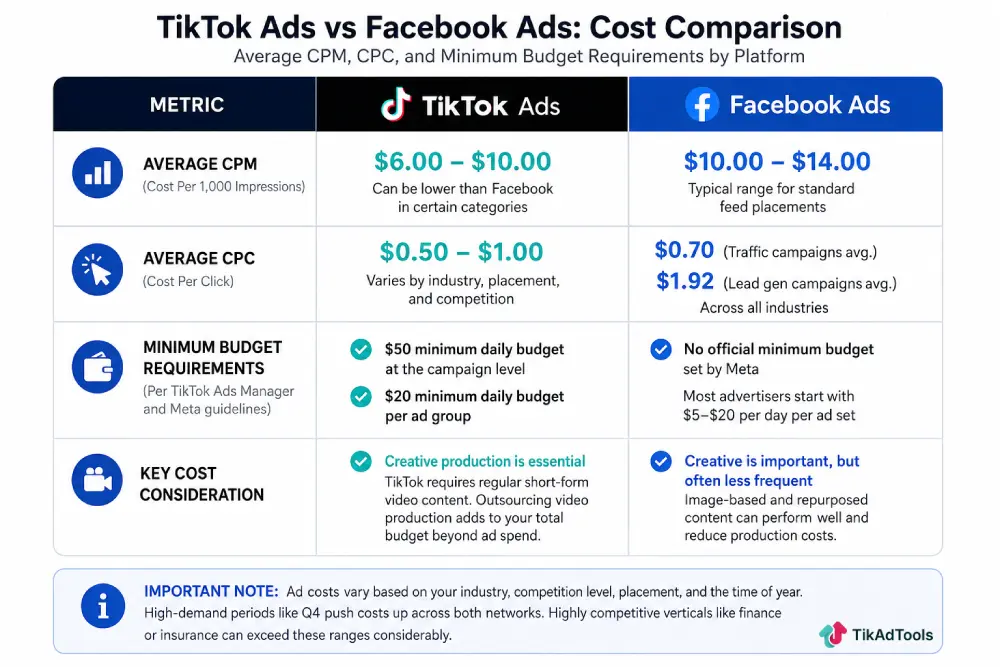
According to LocaliQ’s Facebook Advertising Benchmarks, the average CPC for Facebook traffic campaigns across all industries sits at around $0.70, with lead generation campaigns running closer to $1.92. CPMs typically fall between $10 and $14 for standard feed placements. Highly competitive verticals like finance or insurance can exceed these ranges considerably.
As confirmed by TikTok’s official Ads Manager documentation, TikTok Ads require a minimum daily budget of $50 at the campaign level and $20 per ad group per day. CPMs on TikTok can be lower than Facebook in certain categories, which has attracted brands willing to invest in video production to test the platform.
One cost that is easy to miss: creative production. TikTok’s format demands regular short-form video content, refreshed often, since TikTok’s algorithm rewards freshness and viewers disengage from the same clip quickly. Facebook creative typically holds up longer before it needs replacing, especially for static image and carousel formats.
If you outsource video production, that ongoing refresh cost should factor into your total TikTok budget alongside your actual ad spend, not just a one-time production fee.
Budget scaling also behaves differently once a campaign is working. Facebook generally lets you raise the daily budget on a proven campaign without much disruption. TikTok’s algorithm is more sensitive to sudden budget jumps, so scaling usually means duplicating the campaign with a new audience or format rather than just increasing the number on the one that’s already working.
ROI: which platform actually converts?
There is no universal answer here. ROI depends on your product, funnel, audience, and the quality of your creative.
Facebook Ads consistently perform better for direct-response campaigns and lower-funnel goals. Retargeting website visitors with a follow-up Facebook ad after they browse your product pages is a proven conversion strategy.
Dynamic product ads, which automatically show users the exact items they viewed, work particularly well for eCommerce.
TikTok Ads tend to perform best for brand awareness and upper-funnel reach. Brands that create content that feels native to TikTok, not like a traditional ad, often see strong engagement and organic amplification on top of their paid reach.
Some eCommerce brands have reported solid returns through TikTok Shop integrations, though Facebook’s shopping and retargeting infrastructure is still more established overall.
A practical approach: Use TikTok to introduce your brand to new people, then bring them back with Facebook’s retargeting tools. That combination works well when your budget supports running both.
When TikTok ads are the right choice
TikTok Ads make sense for your business when:
- Your audience is primarily between 18 and 34 years old
- You sell visually interesting or demonstrable products (beauty, food, fitness, fashion, gadgets)
- You can produce short, authentic video content consistently
- Your goal is brand awareness and top-of-funnel reach
- You want to test a new product and get fast feedback from an engaged audience
Brands in beauty, fitness, food, and fashion consistently see strong engagement on TikTok. If your product tells a clear story in under 15 seconds and fits naturally into a casual, entertaining format, TikTok is worth serious budget.
When Facebook ads are the right choice
Facebook Ads are a stronger fit when:
- Your audience is 30 or older
- You need reliable retargeting for site visitors or cart abandoners
- You sell a service or product that requires trust before purchase
- You want to build lookalike audiences from your customer list
- You are running lead generation campaigns with a form or landing page
- You operate a local or service-based business
Facebook also handles B2C brands with longer decision cycles well. Its detailed analytics and attribution tools give you a much clearer view of where your budget is actually producing returns.
TikTok ads vs Facebook ads: side-by-side comparison
| Feature | TikTok Ads | Facebook Ads |
|---|---|---|
| Ad Reach / Monthly Active Users | ~1.9B ad reach (Statista) | 3.07B (last reported separately, now folded into Meta’s combined Family of Apps figure) |
| Core Audience Age | 18-34 | 25-54 |
| Primary Ad Format | Short-form video | Video, image, carousel, more |
| Targeting Depth | Moderate | Advanced |
| Retargeting Capability | Limited | Strong |
| Min. Daily Budget | $50/campaign, $20/ad group | $1/day |
| Algorithm-Driven Distribution | Strong | Moderate |
| eCommerce Integration | TikTok Shop (growing) | Meta Shops (mature) |
| Best Use Case | Awareness, Gen Z reach | Retargeting, broad demographics |
Should you run ads on both platforms?
Many businesses do, and for good reason. TikTok handles discovery. Facebook handles conversion. Running both as a funnel makes sense when your budget supports it.
The challenge is that managing two paid channels doubles your time investment and creative requirements.
If you are just starting out or working with a limited budget, pick the platform where your audience is most active and run a focused test. Once you see what works, you can build from there. The Ad Budget Planner can help you model TikTok spend scenarios by industry and goal before you commit.
If your customers already search for what you sell rather than discover it by scrolling, TikTok Ads vs Google Ads is worth reading before deciding between these two. And if the deciding factor is budget size rather than platform features, the best ad platform for a small budget compares real minimums across all three.
Frequently asked questions
Are TikTok Ads cheaper than Facebook Ads?
Not always. TikTok CPMs can be lower in certain categories, but the platform requires a minimum daily budget of $50 at the campaign level, compared to Facebook’s flexible starting point of around $1 per day. Actual costs depend on your industry, audience size, and how well your creative performs on each platform.
Which platform gives small businesses better bang for their budget?
For most small businesses, Facebook offers more control. You can start small, test different audiences, and use detailed targeting to avoid wasted spend. TikTok can deliver strong reach for the money, but factor in video production costs, since the platform rewards fresh, native-style content rather than static or repurposed ads.
Do TikTok Ads work for businesses targeting older audiences?
TikTok’s user base is growing older, but Facebook still dominates the 35-plus demographic by a wide margin. If your core customers are above 35, Facebook Ads will deliver more reliable reach and conversion results with less creative overhead.
Can I use the same ad creative on both platforms?
You can repurpose video content across both, but the results vary. TikTok’s feed rewards lo-fi, authentic content that feels native to the platform. Facebook supports more polished formats. Ads that look like traditional commercials tend to underperform on TikTok, while highly casual videos may not land as well in certain Facebook placements.
Which platform has better reporting and analytics?
Facebook Ads Manager offers more detailed reporting, including conversion attribution, audience insights, and A/B testing tools. TikTok Ads Manager has improved steadily but is still behind Meta in reporting depth and third-party integrations.
Final thoughts
Choosing between TikTok Ads and Facebook Ads comes down to three things: who your audience is, what content you can realistically produce, and what your campaign goal looks like.
Facebook remains the more dependable platform for most small businesses. Its targeting precision, retargeting capability, and audience breadth make it a lower-risk starting point.
TikTok offers a genuine opportunity, especially for brands targeting younger buyers with strong video content, but it asks for a bigger creative commitment in return.
Pick the platform where your audience already spends time, start with a realistic budget, and let the results guide your next move. The right platform is the one your actual customers use. If you’re still unsure after this comparison, are TikTok ads worth it covers the fuller cost-and-fit picture with a set of calculators to run your own numbers, and which ad platform is right for your business walks through the complete decision framework across all three platforms.
Sources