
If you treat TikTok like Facebook, you will lose money. This is the hard truth that most eCommerce founders learn after wasting their first few thousand dollars on the platform.
The creative that crushes it on Instagram Reels often flops on TikTok. The detailed targeting stacks that worked in 2022 now just strangle the algorithm’s ability to find buyers.
In 2026, TikTok has evolved into a beast that demands a completely different approach. It favors raw authenticity over polish and broad freedom over micromanagement.
With TikTok Shop now a dominant force and ad costs remaining significantly lower than Meta (averaging $3.20 to $10.00 CPM), the opportunity is massive. But the window for easy wins is closing. Success now requires operational discipline.
This guide outlines the specific, operational best practices you need to adopt to lower your CPA (Cost Per Acquisition) and scale your revenue this year.
Get Up to $6,000 in Free TikTok Ad Credits
TikTok offers ad credit incentives for new advertisers, helping you test campaigns with a lower upfront cost.
Table of Contents
Quick summary
- Creative Velocity: You must refresh creatives every 7 to 10 days to combat ad fatigue. This happens much faster on TikTok than on Meta.
- Broad is Better: Avoid narrowing your audience with interest targeting. Leave age, gender, and interests open to let the AI find your buyers.
- The Spark Standard: Use Spark Ads (boosting organic posts) for at least 70% of your spend to build on social proof and authenticity.
- Value-Based Bidding: Move away from Lowest Cost and test GMV Max or Minimum ROAS bidding to prioritize high-value cart sizes.
- The First 3 Seconds: If your hook doesn’t visually disrupt the feed instantly, your conversion rate will suffer regardless of the product quality.
What are TikTok ad best practices?
TikTok ad best practices are a set of strategic guidelines that prioritize creative relevance and algorithmic freedom over manual targeting.
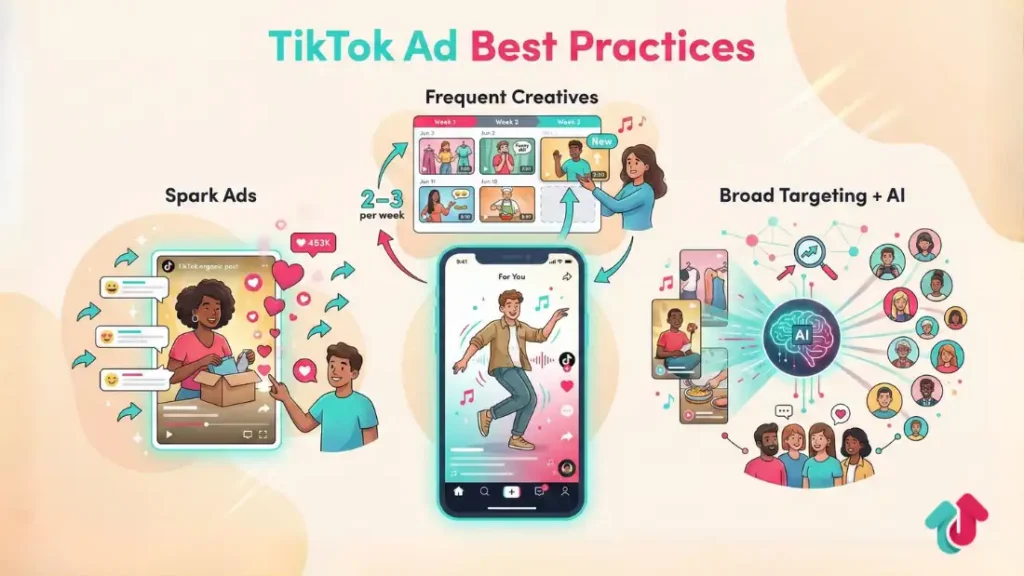
For eCommerce, this means utilizing Spark Ads to boost authentic content, maintaining a high frequency of new video creatives (2-3 per week), and leveraging broad targeting to allow the system’s machine learning to identify customers based on user intent and viewing behavior.
1. Creative strategy: the lo-fi rule
The biggest mistake brands make is overproducing their ads. On TikTok, commercials are skipped. Content that looks like a user review is watched.
Shoot Native
Your video must look like it was filmed on a phone.
- Aspect Ratio: Always 9:16.
- Audio: Sound is mandatory. Use a voiceover or a person speaking directly to the camera.
- Text Overlays: Use the native TikTok font styles for captions. If you burn in fancy Adobe Premiere fonts, it signals this is an ad to the user’s brain.
The 3-Second Hook Architecture
You do not have time for a slow buildup. You must disrupt the scroll immediately.
- Visual Disruption: Start with movement. Someone running, a product falling, or a weird texture.
- The Negative Hook: Stop using your retinol like this. often performs better than This retinol is great.
- The Reply Hook: Use the Green Screen effect to reply to a comment asking about the product. This builds instant trust.
2. Account structure: simplify to scale
In 2026, complexity is the enemy of performance. If you have 20 different ad groups with $20 budgets, you are fracturing your data.
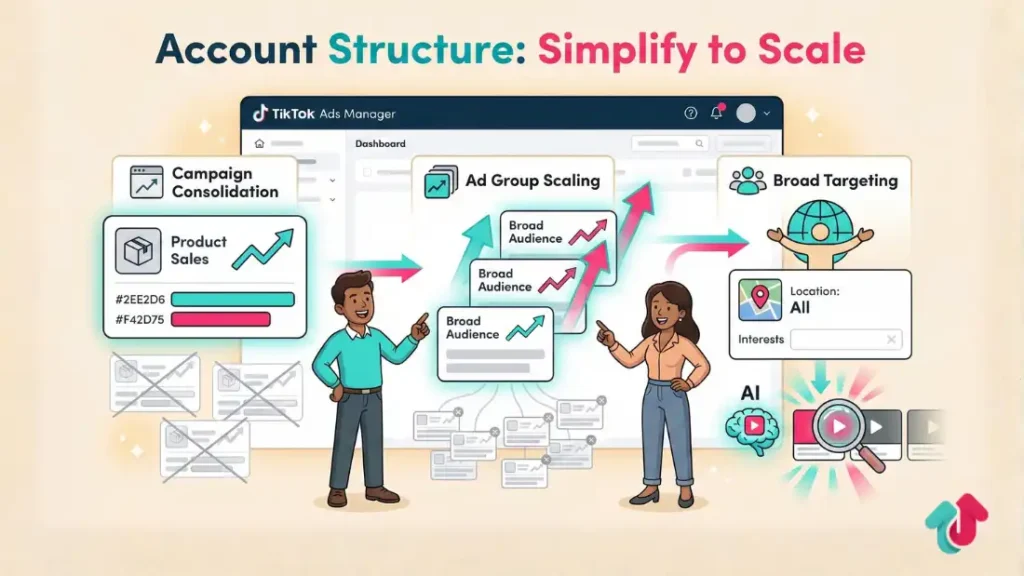
Consolidate Your Campaigns
- Campaign Objective: Stick to Website Conversions or Product Sales (for TikTok Shop).
- Ad Groups: Run fewer ad groups with higher budgets.
- The Rule: Each ad group needs roughly 50 conversions per week to exit the learning phase. If your budget is too low to achieve this, combine your audiences.
Stop Interest Stacking
Trust the algorithm. When you select specific interests (e.g., Clothing plus Shoes), you are limiting the pool of potential buyers.
Best Practice: Use Broad Targeting. Set the location to your shipping countries and leave everything else blank. The algorithm analyzes your video content to determine who should see it.
3. Bidding and optimization in 2026
How you pay for your ads matters just as much as the creative.
Lowest Cost vs. Cost Cap
- Lowest Cost (Standard): Best for launching new accounts. It spends your full daily budget and gets the most results possible. Use this to gather data.
- Cost Cap: Best for scaling. You tell TikTok, I don’t want to pay more than $20 per sale. It will only spend when it thinks it can hit that target. This protects your profitability but might limit your spending volume.
Understanding GMV Max
For TikTok Shop merchants, GMV Max is the new gold standard. Instead of bidding for a purchase, you bid for Total Gross Merchandise Value.
This tells the AI to ignore low-value shoppers and hunt for users likely to buy bundles or premium items.
Comparison: bidding strategies for eCommerce
| Strategy | Best Used For | Risk Level |
|---|---|---|
| Lowest Cost | New product launches & gathering data | High (Will spend the budget regardless of results) |
| Cost Cap | Protecting profit margins on established products | Medium (Might not spend if bid is too low) |
| GMV Max | Maximizing total revenue (TikTok Shop only) | Low (Optimizes for ROAS automatically) |
4. Combating creative fatigue
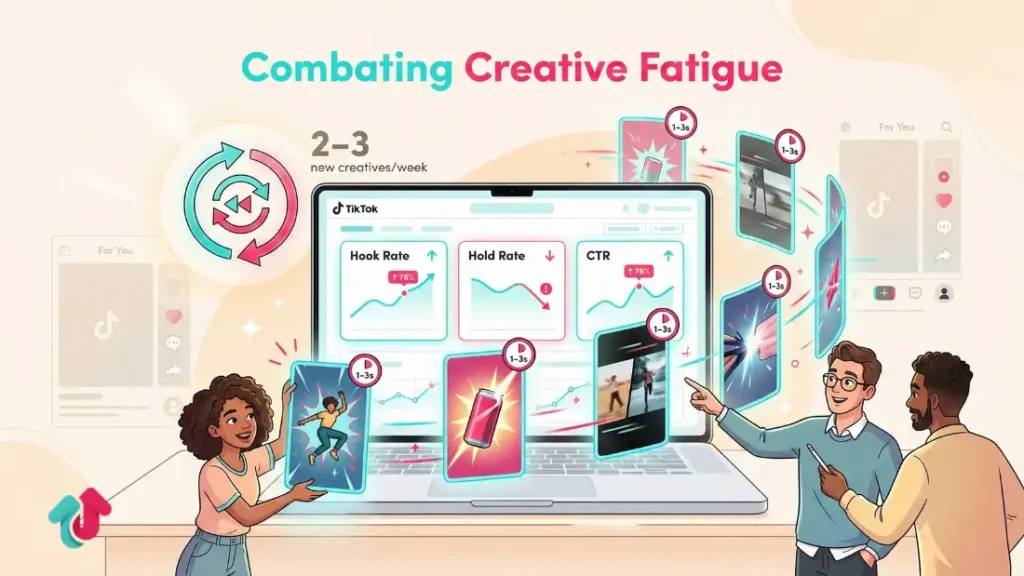
On Facebook, an ad might work for months. On TikTok, an ad might work for 10 days.
The Refresh Rate
- Volume: Aim to test 2 to 3 new creatives every week.
- Variations: You don’t need to shoot a whole new video. You can take a winning video and just change the first 3 seconds (the hook). This counts as a new ad to the algorithm and can extend the life of your content.
Monitoring Metrics
Do not look at Likes. Look at:
- Hook Rate: (3-second views / Total impressions). Aim for >25%.
- Hold Rate: (Average watch time / Total video length). Aim for >6 seconds.
- CTR: If it drops below 0.7%, it is time to kill the ad.
FAQ: Common challenges for retailers
How much budget do I need to test properly?
You should allocate at least $50 to $100 per day for a proper test. This allows you to test 2-3 different videos simultaneously. If you spend less, the data will be too slow to be actionable.
Should I use smart creative ads?
Yes. Smart Creative (part of the new automation suite) takes your videos, text, and CTAs and mixes them automatically to find the best combination. It is highly effective for preventing creative fatigue without doing manual work.
What is the best time to post or run ads?
For ads, time of day matters less than you think. The algorithm shows your ad when your target user is active. However, launching new campaigns after midnight (12:00 AM local time) is a best practice. It gives the system a full 24 hours to pace the budget evenly.
Why are my ads getting clicks but no sales?
This is usually a landing page issue, not an ad issue. Check your load speed. If your mobile site takes more than 3 seconds to load, TikTok users will bounce. Also, ensure your offer (price plus shipping) is competitive.
Can I reuse my Instagram reels as TikTok Ads?
Only if you remove the metadata and watermarks. If you upload a video with the Instagram Reel logo or music that isn’t licensed for commercial use, TikTok will suppress it. Always edit the raw file and add TikTok-native text.
What is the difference between Spark Ads and Non-Spark Ads?
Spark Ads are linked to a real TikTok account and boost organic posts. They track profile visits and followers. Non-Spark Ads (or dark ads) have a clickable profile picture but do not link to a real profile. Spark Ads generally convert 30-40% better due to social proof.
Conclusion
Winning on TikTok in 2026 doesn’t require a Hollywood budget or a team of data scientists. It requires a shift in mindset.
You must be willing to let go of granular control over targeting and focus your energy on creative volume.
The brands that win this year will be the ones that act like creators first and advertisers second.
They will use Spark Ads to build trust, Broad Targeting to find scale, and they will never stop testing new hooks.
Your next best-performing customer is scrolling right now. You just need to make the video that stops them.